ITEM PF6E
PENSION FUND COMMITTEE – 15 NOVEMBER 2002
OVERVIEW AND OUTLOOK FOR INVESTMENT MARKETS
Report by
the Independent Financial Adviser
General
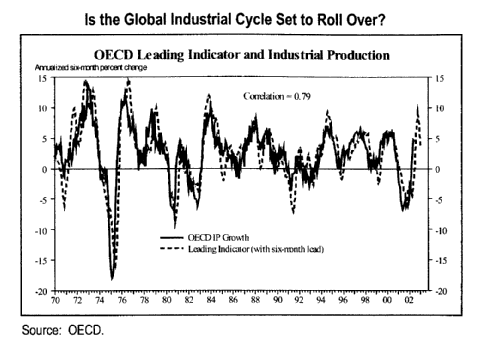
- The OECD leading indicator for economic activity has come back further in recent weeks, signalling that the recovery in economic growth is faltering.
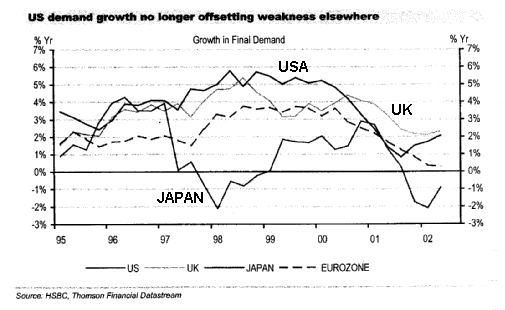
- The problem is that most growth in the developed world is being generated by final demand, principally the consumer (who is already heavily borrowed) in the USA and the UK as the following chart shows.
- However, US consumer confidence is now at a nine year low, while there have been indications that the growth in UK consumer expenditure might be slackening. The US, and to a lesser extent the UK, have reduced interest rates sharply and more recently have substantially increased government expenditure, whereas the European Central Bank with its inflexible inflation target of 0-2% has only reduced interest rates modestly, while countries in the Eurozone are constrained from increasing government expenditure by the stability and growth pact. Japan, the second largest developed world economy, is still mired in recession though political gridlock. Thus, the possibility of a double dip recession cannot be excluded.
- Equity markets
have fallen very substantially since their peaks in the year 2000, and
there has been a modest bounce since the lows of this cycle around 9
October 2002 as the table below shows.
Fall
High to LowBounce
From LowUK -45% + 9% USA -49% +16% Germany -68% +19% France -62% +15% Japan (Peak 1990) -78% + 4% UK Techmark -96% +28% (but from a
very low base)US NASDAQ
(Proxy for Technology)
-78% +19%
Consensus
forecasts for economic growth have been reduced, but are still probably
far too optimistic.
| Consensus GDP Growth forecasts | 2002 | 2003 |
| UK | 1.6% | 2.6% |
| US | 2.4% | 3.1% |
| Eurozone | 1.0% | 2.3% |
| Japan | -0.8% | 1.0% |
Markets
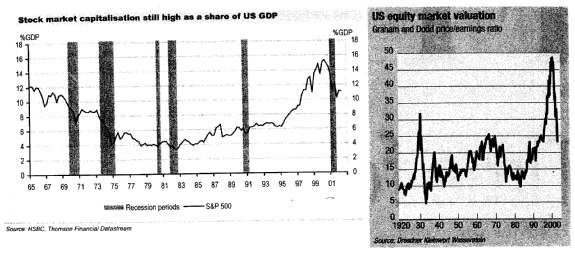
- However, it is difficult to say that the market low for this cycle has occurred with economic recovery faltering and so pressure on profits being resumed, and with continuing international uncertainty over Iraq. Further, while the UK and Eurozone markets are now reasonably valued, the US market is still overvalued on a longer-term basis as the following two charts show.
- If the US market falls back to a more reasonable valuation, it will inevitably tend to drag other western markets down with it. However, some technical analysts who study charts are beginning to call for a new bull market starting early next year.
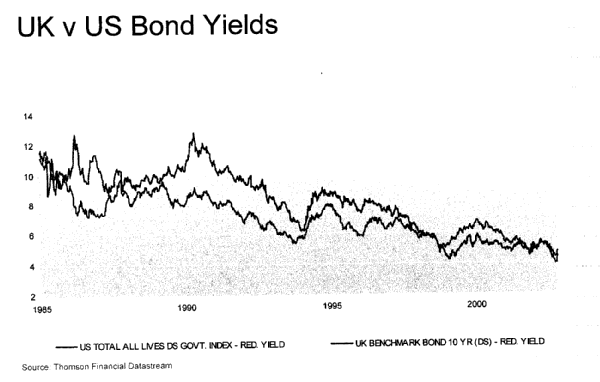
- Government bond yields in the UK and USA have fallen from around 12% in the late 1980’s to the current 4%- 4½%, as the following chart shows, and there has been a similar move in the Eurozone.
- Unless the world moves into deflation, it is difficult to see yields going much lower, particularly if economic recovery becomes more firmly established next year.
- The following charts of individual country equity indices show western equity markets developed an asset bubble in the late 1990’s well above the long-term trend. As with Japan, which developed such a bubble in the 1980’s, it may take some time for the distorting effects to be worked off.
A
F BUSHELL
Independent
Financial Adviser
November
2002
Return to TOP